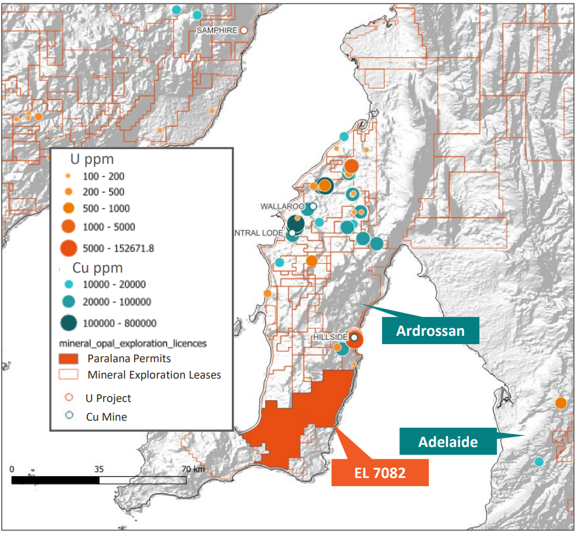
EL 7082 – Pirie Basin
Overview
EL 7082 is a large, contiguous exploration licence covering approximately 916 km² on the southern Yorke Peninsula in South Australia. The project sits within the southern extension of the Olympic Dam Province, one of the world’s most significant mineral regions, and is located approximately 30 km from port infrastructure at Ardrossan and ~16 km south of the Hillside Copper Project.
Prospectivity
EL 7082 is prospective for both sandstone-hosted uranium and IOCG-style copper–gold–uranium systems. The project sits along a structural and geological trend that hosts known deposits and occurrences, including Hillside and Samphire, and is interpreted as the southern continuation of these systems.
Multiple independent indicators support prospectivity, including favourable basin architecture, regional uranium occurrences, and structural corridors capable of focusing mineralising fluids. Importantly, the system remains largely untested at depth.
Geology
The project is located on the southern margin of the Gawler Craton, within a basin architecture capable of supporting multiple mineral systems. This includes both sedimentary uranium systems and hard-rock IOCG-style mineralisation.
Key geological features include:
- Craton–basement architecture conducive to mineralisation
- Major terrain-bounding faults acting as fluid pathways
- Stratigraphic and structural analogues to known deposits
- Underexplored basin depth potential
Together, these elements provide the fundamental ingredients required for mineral system development.
Exploration
Exploration at EL 7082 is being advanced through a disciplined, staged program designed to maximise information before capital deployment. This includes:
- Integration of regional gravity, magnetics and seismic data
- Play-based geological mapping and target refinement
- Leveraging newly available high-quality datasets, including modern 2D seismic and airborne multiphysics
- Targeted drilling of high-conviction prospects
Potential
EL 7082 offers exposure to multiple mineral systems within a single tenure, providing portfolio-style upside.
The combination of scale, location, geological setting and data availability positions the project to deliver:
- Near-surface sedimentary uranium opportunities
- Deeper IOCG-style targets along established structural trends
- Multiple independent drill targets rather than a single prospect
This creates the potential for both early-stage discovery and longer-term district-scale development.
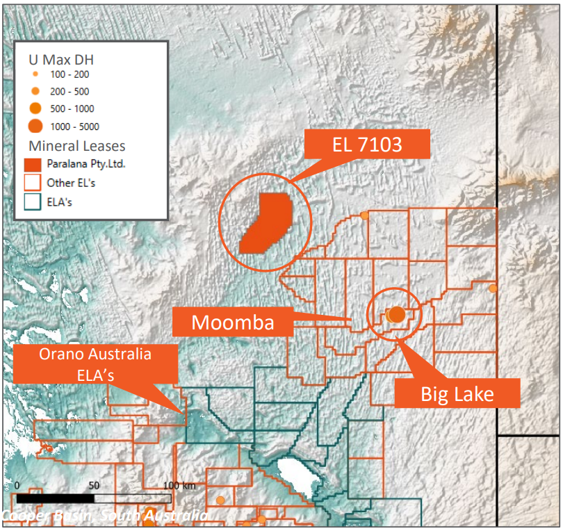
EL 7103 – Cooper Basin
Overview
EL 7103 covers approximately 997 km² in the Cooper Basin, one of Australia’s most extensively explored sedimentary basins. While the basin has been intensively developed for oil and gas over several decades, it remains largely unexplored for uranium.
This creates a unique opportunity to leverage a world-class subsurface dataset, including dense seismic coverage, well control and wireline logs, to target uranium systems that have not historically been the focus of exploration.
Prospectivity
The Cooper Basin project targets sedimentary-hosted uranium systems analogous to the Big Lake discovery.
Prospectivity is driven by:
- Basin-scale geological understanding from petroleum exploration
- Proven uranium occurrences associated with regional structural features
- Favourable stratigraphic and redox conditions for uranium deposition
The project represents an opportunity to apply modern mineral exploration techniques to a basin that has historically been explored for hydrocarbons, not minerals.
Geology
The Cooper Basin provides a well-constrained geological framework, with extensive well control, wireline logs and seismic data defining basin architecture.
Key geological characteristics include:
- Thick sedimentary sequences capable of hosting uranium systems
- Regionally extensive aquifers and fluid pathways
- Structural controls linked to major basin features
- Analogues to known sedimentary uranium systems
This level of geological understanding significantly reduces early-stage uncertainty.
Exploration
Exploration is focused on integrating existing datasets to identify uranium-favourable fairways and refine targets prior to drilling.
Planned activities include:
- Basin-scale play mapping and ranking
- Integration of seismic, well and geophysical data
- Identification of redox boundaries and fluid pathways
- Progressive target refinement leading to drill-ready prospects
The approach prioritises data-driven targeting, leveraging existing information to minimise exploration risk.
Potential
EL 7103 provides exposure to a new uranium frontier within a basin that has already been extensively characterised for hydrocarbons but remains underexplored for minerals.
The project offers:
- Low-cost entry into a high-quality subsurface dataset
- Potential for repeatable, basin-scale uranium discoveries
- Alignment with proven exploration concepts validated by prior discoveries
This positions the project as a capital-efficient pathway to discovery.